

EPR 100 Award

Centralized EU EPR registration service
Service availability, categories and fees vary by market and turnover, so businesses should always confirm current coverage and legal obligations on Lovat’s website or with their own adviser before relying on this service.

Packaging AR service across the EU-27
Lizenzero offers a dedicated authorised representative service for packaging, helping foreign traders comply with national laws and upcoming PPWR rules while managing dual-system participation and LUCID reporting in Germany

Multi-country AR for packaging, WEEE and batteries
The available AR service, product categories and language support differ by country, so producers should verify which markets and waste streams are covered for their specific products.

Specialist UK EPR reporting software
Its guidance reflects evolving UK regulations, but users remain responsible for checking regulatory changes, maintaining accurate source data and confirming that submissions meet official requirement

International EPR & AR service for multiple waste-streams
The scope of AR duties, countries covered and fees vary according to your product portfolio and sales footprint, so businesses should always validate service terms, legal responsibilities and local compliance requirements before appointing take-e-way.

French PRO for household packaging
Membership conditions, fees and reporting duties are set by French EPR rules and may change over time, so companies should always review the latest Léko documentation and legal guidance for their product range.

Italy’s multi-stream EPR system
Membership terms, applicable waste streams and reporting obligations depend on the producer’s product portfolio, so companies must verify their own responsibilities under Italian and EU law when joining Erion.

Integrated EPR and resource-management solutions
Specific solutions are tailored to the customer’s markets, obligations and existing data, so businesses should confirm scope, responsibilities and legal assumptions in their service agreement and local regulations.

UK’s largest packaging compliance scheme
Valpak is the UK’s largest producer compliance scheme for packaging, WEEE and batteries, offering data tools and expert support to help businesses meet Extended Producer Responsibility and reporting obligations.

German Green Dot packaging compliance
Solutions and prices depend on packaging materials and volumes placed on the German market; producers must still ensure that their registrations, declarations and labelling fully meet statutory requirements.



Top 10 Extended Producer Responsibility Software Solutions
Choosing the right EPR reporting software is now a core business decision, not just an IT task. More than 65 countries require producers to register, report, and fund end-of-life treatment for packaging, electronics, batteries, and textiles. A wrong tool means missed deadlines, incorrect fee calculations, and regulatory penalties. This guide covers what EPR is, how obligations differ by waste stream, and which features matter most when selecting a platform.
What Extended Producer Responsibility Means in Practice
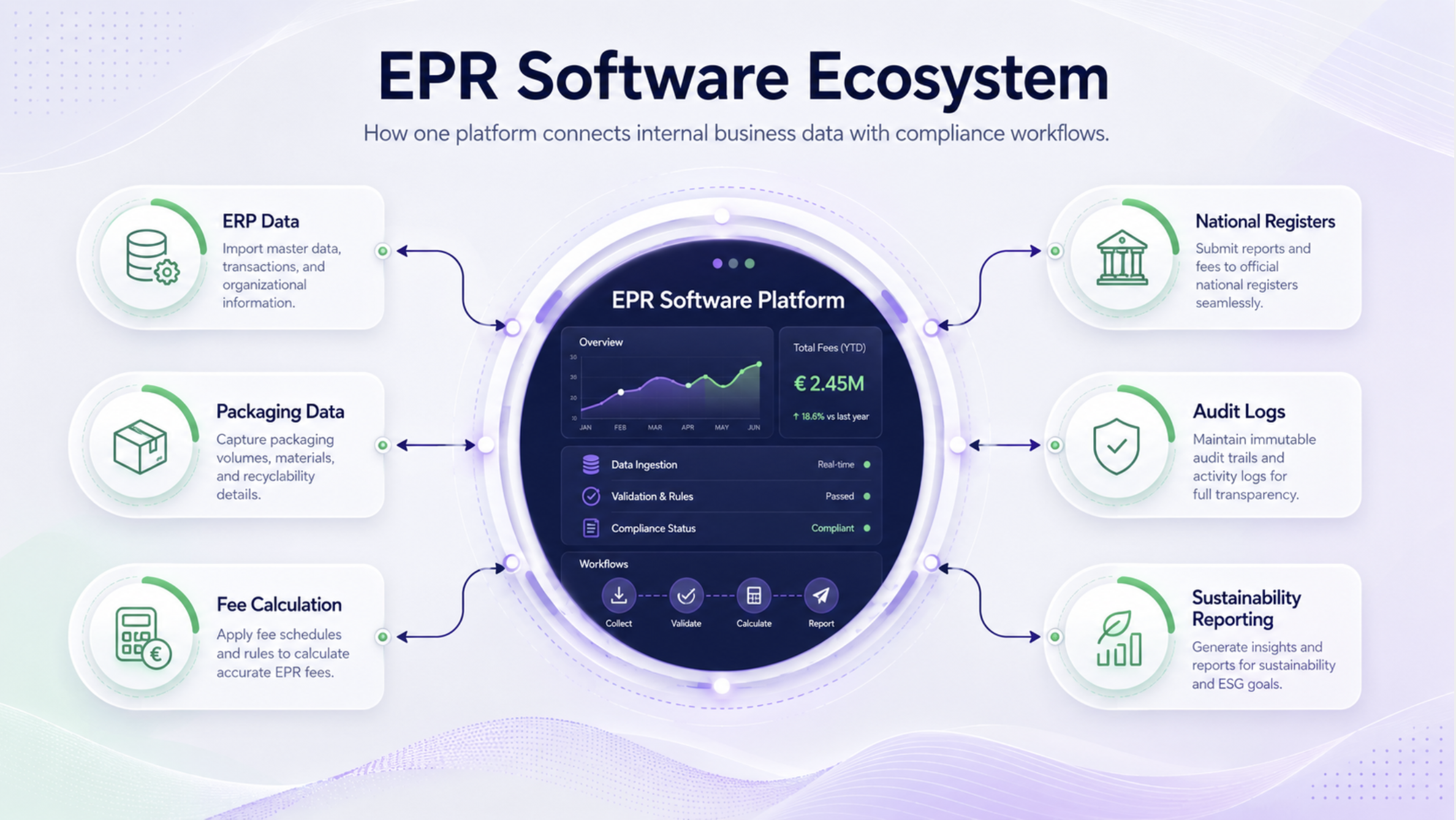
Extended Producer Responsibility shifts waste management costs from local governments to the companies that place products on the market. A producer — any brand owner, importer, or online marketplace — must join a compliance scheme, declare the weight and material of goods sold, and pay fees that fund collection and recycling infrastructure. Environmental compliance software automates data gathering, calculates fees, and submits declarations before deadlines. Without automation, finance teams spend weeks each quarter on manual data preparation.
The framework traces back to Germany in the early 1990s, where the first packaging take-back system launched. The EU has since extended EPR across multiple categories through the Packaging and Packaging Waste Regulation, the WEEE Directive, the Batteries Regulation 2023/1542, and the Single-Use Plastics Directive. Each piece of legislation sets its own data requirements, reporting intervals, and national registers. For any business selling across borders, this creates a layered compliance obligation that grows with every new market entered.
Companies that underestimate EPR complexity face tangible consequences. Penalties across EU member states range from a few thousand to several hundred thousand euros per violation. Sustainability software that stays current with regulatory changes provides a measurable financial safety net and reduces the time compliance teams spend tracking legislative updates manually.
Core Waste Streams Covered by EPR Legislation
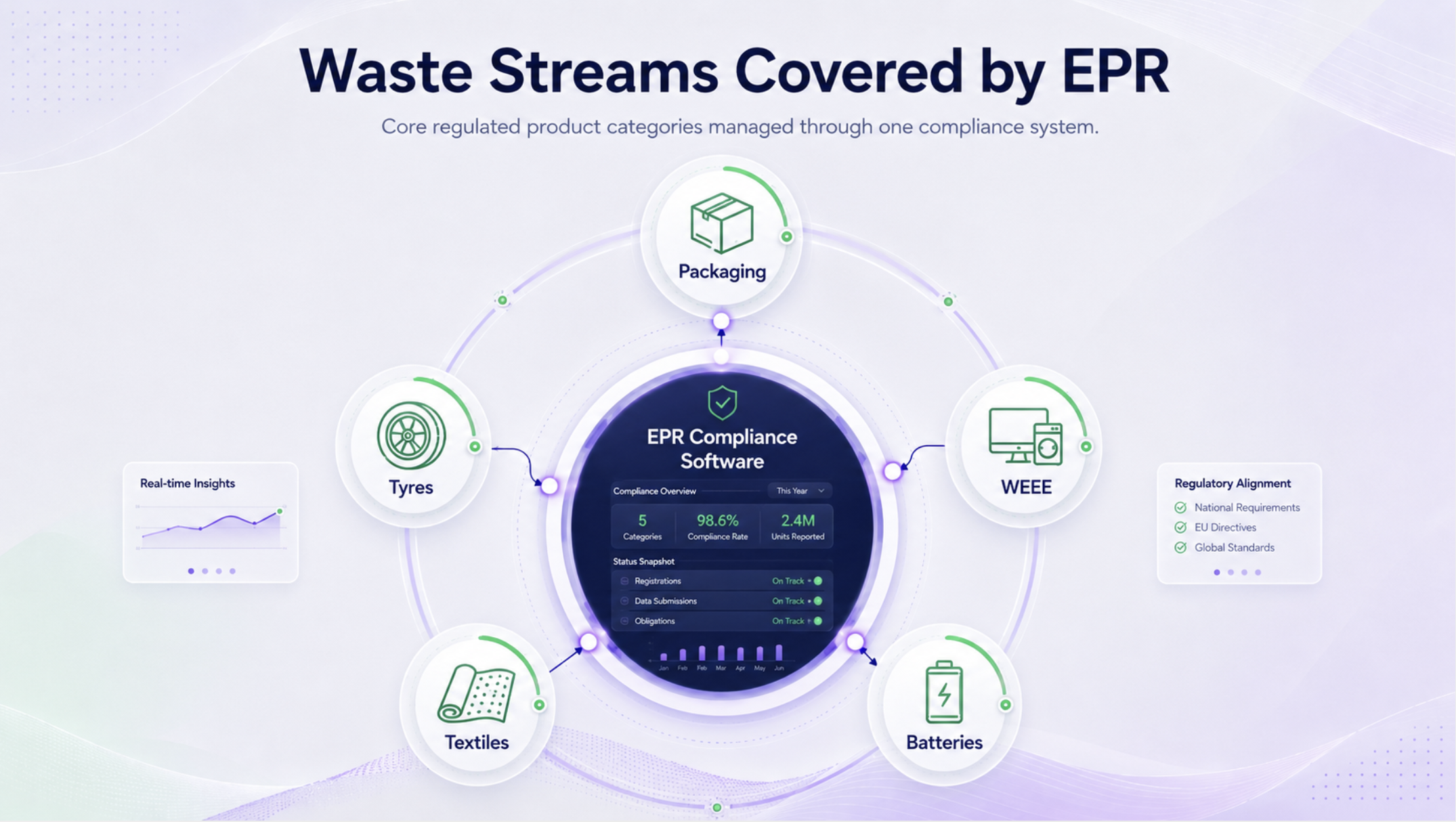
Different product categories fall under different EPR regimes. Understanding each stream is the first step toward selecting tools that match actual obligations rather than assumed ones.
Packaging is the broadest stream. It covers plastic, glass, metal, paper, and composite materials used to protect goods during transport or at point of sale. Most EU member states operate a national packaging register, and online sellers must appoint an authorised representative in each country where they lack a legal entity. Waste management software for this stream tracks material type, weight per SKU, and country-specific fee tables updated at least once a year.
WEEE covers large household appliances, small electronics, smartphones, and solar panels. Producers register in national registers and contribute to collection networks. Data requirements — product category, unit weight, and country of placement — must be reconciled quarterly or annually depending on the member state. Platforms handling WEEE need to manage multiple product classifications and collection targets simultaneously.
Battery EPR is governed by EU Batteries Regulation 2023/1542. It introduces carbon footprint declarations, due-diligence requirements for cobalt and lithium, and a digital battery passport for industrial and electric vehicle batteries by 2027. Recycling software for this stream must update continuously as secondary legislation is adopted, making vendor update speed a critical evaluation factor.
Textiles EPR is mandatory in France and under preparation across several other EU member states. Brands must fund collection infrastructure for clothing and household linens. Fewer compliance platforms cover this stream today, so apparel producers should verify coverage explicitly before committing to any tool.
| Waste stream | Key EU regulation | Main data required | Reporting frequency |
| Packaging | PPWR (2025) | Material type, weight, country | Annual or quarterly |
| WEEE | Directive 2012/19/EU | Product category, weight, units | Quarterly or annual |
| Batteries | Regulation 2023/1542 | Chemistry, weight, carbon footprint | Annual + passport by 2027 |
| Textiles | National laws (France first) | Units, material mix, market | Annual |
| Tyres | National laws vary | Units, weight class | Annual |
How EPR Reporting Software Processes Compliance Data
Modern EPR reporting software connects internal data sources with external compliance portals in four stages. First, the platform pulls weight, material, and country-of-sale data from connected ERP systems or manual uploads. Second, it applies country-specific fees, material modulation factors, and recycled-content discounts to produce a liability figure. Third, it formats data to match national register templates and submits declarations on approval. Fourth, every action is logged with timestamps and user identifiers to support regulatory audits.
Integration depth varies significantly between platforms. Some connect via API to registers in Germany (LUCID), France (ADEME), Spain (MITERD), and Italy (Conai). Others require manual file export and re-upload. Compliance management software with direct register connections reduces re-entry errors and shortens the reporting cycle by several days per market — a meaningful saving for teams managing 10 or more countries.
Data quality matters as much as software functionality. Platforms that flag missing product weights, unclassified materials, or unusual volume spikes before submission prevent the most common compliance errors. Catching issues at data entry is faster and cheaper than correcting a declaration that has already been submitted to a national register.
Key Features in Environmental Management System Software
The table below compares feature categories that separate entry-level tools from enterprise-grade environmental management system software. Buyers should treat this as a minimum checklist before shortlisting any vendor.
| Feature | Basic tool | Mid-range platform | Enterprise solution |
| Countries supported | 1–3 | 5–15 | 20+ |
| Waste streams | Packaging only | Packaging + WEEE | All streams |
| ERP integration | Manual CSV | API connectors | Full bi-directional sync |
| Audit log | Basic | Timestamped | Role-based + export |
| AR service | Not included | Optional add-on | Included or partnered |
| Regulatory update speed | Manual by user | Monthly by vendor | Within 48 hours |
| Multi-language support | English only | 2–3 languages | 10+ languages |
When evaluating tools, always ask each vendor how long it takes to update fee tables after a national decree is published. The fastest platforms push updates within 48 hours. Slower ones can lag by several weeks, leaving customers relying on outdated data during live declaration periods.
ERP Software for Small Business and Enterprise EPR Needs
Compliance tools serve very different audiences. Micro businesses, mid-market companies, and large multinationals each need a different combination of features, pricing, and support. Sustainability software that works for a startup selling in two countries is unlikely to meet the needs of a multinational operating across 20 markets.
Small and medium enterprises selling in one or two markets need a lightweight, affordable tool. ERP software for small business sometimes bundles basic EPR compliance modules alongside invoicing and inventory management. These all-in-one tools reduce upfront cost but may lack the depth required for complex multi-country or multi-stream obligations. Buyers at this level should confirm that EPR fee tables in the platform are updated by the vendor, not left to the user.
Mid-market companies selling across five or more EU countries need a dedicated platform. They benefit from automated fee calculations, direct register connections, and multi-currency invoicing. The additional cost over a basic tool is typically recovered within one reporting cycle through time saved on manual data preparation.
Multinational corporations require a platform that consolidates data from multiple subsidiaries, handles legal entity structures, and produces outputs for CSRD and GRI reporting. At this level, environmental compliance software typically integrates with SAP or Oracle as its primary data source and exports directly into sustainability reporting frameworks.
| Business size | Annual turnover | Recommended tool type | Key priority |
| Micro / SME | Under €2M | All-in-one ERP software for small business with EPR module | Low cost, easy setup |
| Mid-market | €2M–€50M | Dedicated EPR compliance platform | Multi-country automation |
| Large enterprise | Over €50M | Enterprise EMS with EPR suite | Integration, audit, ESG |
Top ERP Platforms and How the Market Is Structured
The market for top ERP platforms has matured significantly since 2020. Before that point, most businesses managed obligations through spreadsheets or by outsourcing entirely to producer responsibility organisations. Today four distinct categories compete for market share, each with different strengths and limitations. Evaluating sustainability software across these categories requires more than a feature comparison — it requires understanding what level of regulatory depth each type can deliver.
The main platform types currently available are:
- Compliance-first SaaS platforms built specifically for EPR. They offer the deepest regulatory coverage and the fastest update cycles when legislation changes. Best suited to businesses where EPR is a primary compliance function.
- Sustainability reporting software suites that include EPR as one module alongside carbon accounting, water, and biodiversity metrics. These suit businesses already investing in CSRD reporting and wanting a single data environment.
- PRO-managed portals offered directly by producer responsibility organisations. They handle declarations for their own scheme only and do not support multiple competing schemes in the same market.
- ERP add-on modules from large enterprise software vendors. Coverage is broad but often shallow, and regulatory updates may lag behind changes by several months.
Comparing waste management software across these categories requires looking beyond the feature list. Total cost of ownership — including setup, training, AR fees, and annual updates — often differs more between vendors than the headline licence price suggests.
Ecomodulation and Fee Structures in Recycling Software
EPR fees are not flat rates. Most EU member states apply ecomodulation, a mechanism that adjusts fees based on the environmental profile of the packaging material. Packaging made with recycled content pays lower fees. Packaging that is difficult to sort or recycle pays a premium. Recycling software that applies ecomodulation correctly can save businesses significant sums — sometimes tens of thousands of euros per year for high-volume producers.
| Material type | Fee direction | Ecomodulation factor | Practical impact |
| Clear PET with recycled content | Lower | –20% to –40% | Incentivises recycled input |
| Black plastic (non-sortable) | Higher | +50% to +100% | Penalises hard-to-sort formats |
| Composite / multi-layer | Higher | +30% to +60% | Discourages unrecyclable laminates |
| Paper / cardboard FSC certified | Lower | –10% to –20% | Rewards certified sourcing |
| Glass (clear) | Neutral | 0% | Standard rate applies |
Platforms that model fee scenarios before material decisions are finalised turn compliance into a design input. A procurement team that switches from a non-sortable black plastic lid to a clear alternative can calculate the EPR fee saving immediately. Environmental management system software with built-in scenario modelling supports this kind of decision at the point where it still has a cost impact.
How Sustainability Software Supports EPR Compliance Goals
Under the EU Corporate Sustainability Reporting Directive, large companies must disclose material environmental topics including waste and circular economy performance. EPR declarations provide a ready data source for these disclosures. Sustainability reporting software that maps EPR outputs to GRI 306 (Waste) and ESRS E5 (Resource Use and Circular Economy) eliminates duplicate data entry across separate tools and reduces external assurance costs.
The connection works in both directions. Tonnes placed on the market, recycling rates achieved, and fees paid all feed into annual sustainability reports. Companies using integrated platforms avoid reconciling data between systems at year-end. Smaller businesses not yet subject to CSRD still benefit: brand owners and retailers increasingly require structured environmental data from supply chain partners, and clean EPR records shorten the response time significantly.
Environmental compliance software that produces export-ready datasets in ESRS and GRI format reduces the cost of external assurance. Auditors charge by time, and well-structured source data means fewer clarification rounds and a shorter overall process.
Compliance Management Software and Authorised Representatives
Foreign companies selling into the EU must appoint an authorised representative in each member state where they lack a legal entity. The AR accepts legal responsibility for EPR declarations on the producer’s behalf. Compliance management software that integrates AR services eliminates data mismatches between what the producer declares and what the AR submits to the register — a common and costly error when the two systems are managed separately.
Integration between the platform and the AR matters because the AR needs access to the same declaration data the software holds. Key questions to ask when evaluating platforms with AR services:
- In which member states does the provider hold approved AR status.
- How fee payments to PROs are handled — directly by the producer or through the AR.
- What happens if the AR loses its approval status during the compliance year.
- Whether the AR service is priced per country or as a bundled package.
- How quickly the AR responds when a register requests additional supporting documentation.
- Whether the platform logs AR actions separately for internal audit purposes.
The answers differ significantly between providers and affect total compliance cost more than many buyers anticipate. EPR reporting tools that manage AR relationships internally remove one coordination layer from the compliance team and reduce the risk of declaration mismatches at submission time.
Waste Management Software for EPR Registration in New Markets
First-time producers often find registration more complex than ongoing reporting. Each country has its own register, its own form format, and its own approval timeline. Waste management software with built-in registration workflows guides users through country-specific steps without requiring in-house legal expertise on every market. Platforms that pre-fill templates and link directly to national portals reduce average registration time by several days per country.
The general process follows a consistent sequence across most EU markets:
- Identify which waste streams apply to your product portfolio and in which countries obligations arise.
- Determine whether you need a local legal entity or an authorised representative in each target market.
- Register with the national compliance scheme or PRO in each country before placing products on the market.
- Submit an initial declaration of volumes placed on the market in the reference period.
- Pay the applicable fee based on material type, weight, and ecomodulation adjustments.
- Set up ongoing data collection workflows to support accurate quarterly or annual reporting.
Recycling software that covers all six steps in a single guided flow reduces the risk of omissions during initial setup. Errors at the registration stage — wrong material category, missing weight data, wrong legal entity — cascade into every subsequent declaration until corrected.
Future EPR Legislation and What It Means for Software Requirements
EPR regulation is expanding, not stabilising. The EU Packaging and Packaging Waste Regulation adopted in 2025 introduces mandatory recycled content targets, packaging minimisation requirements, and reuse targets for specific categories. Environmental management system software will need to track not just weight placed on the market but also the recycled content percentage in each material layer — a more granular data requirement than most existing tools were designed to handle.
Digital product passports are required for batteries from 2027 and are under consideration for textiles and electronics. These passports require platforms to store and transmit structured product-level data across supply chains. This shifts EPR compliance from a weight-based annual declaration toward a product-level data management function that operates continuously throughout the year.
The EU Extended Producer Responsibility Coordination Platform, established under the PPWR, will harmonise reporting formats across member states progressively. Producers using EPR reporting software that aligns early with harmonised data formats will avoid costly migrations when standardisation becomes mandatory. Selecting a vendor with a dedicated regulatory team and a documented update policy is the most practical way to stay ahead of these changes.
Practical Checklist for Selecting Compliance Management Software
Choosing compliance management software is a commitment with multi-year consequences. A rushed procurement often leads to expensive migration within 18 to 24 months. The checklist below captures the most important evaluation criteria before signing any contract.
- Confirm coverage of all countries where you currently place products on the market.
- Verify that fee tables and national register requirements update automatically after legislative changes.
- Check that the platform provides audit-ready data exports in formats accepted by each national authority.
- Request client references from businesses of similar size and sector.
- Test data import from your existing ERP or e-commerce platform before committing.
- Review the contractual notice period and confirm data export rights in case of switching.
- When shortlisting top ERP platforms, always request a regulatory changelog covering the past 24 months to evaluate how actively the vendor tracks legislative changes
- Confirm whether the platform supports multi-entity reporting for group structures with subsidiaries.
Sustainability software that performs well on all eight criteria is unlikely to create compliance failures even as regulations continue to evolve. A gap in two or more areas represents a risk that compounds with every new directive adopted. The right platform is one that the compliance team can rely on without constant manual oversight.
FAQ
EPR reporting software is a digital tool that helps producers collect, calculate, and submit the data required under Extended Producer Responsibility regulations. Any company that manufactures, imports, or sells packaged goods, electronics, batteries, or other regulated products in the EU or UK is likely to need it. The exact obligation depends on product category, volume placed on the market, and countries of sale.
Environmental compliance software is built specifically to track regulatory obligations tied to product types and waste streams. Standard ERP systems manage financial transactions, inventory, and procurement but rarely include country-specific fee tables, material classification frameworks, or national register integrations. Some large ERP vendors offer compliance modules, but dedicated tools typically provide deeper regulatory coverage and significantly faster regulatory updates.
Several platforms offer tiered pricing for businesses placing smaller volumes on the market. Entry-level sustainability reporting software can cost under €100 per month for a single country. Small producers should compare total cost carefully — AR fees and PRO membership fees are typically charged separately from the software subscription and can exceed the licence cost in some markets.
EPR rules change frequently — sometimes several times per year at national level. Fee tables typically update annually, and material classification rules shift when directives are transposed into national law. The strongest compliance management software platforms maintain dedicated regulatory teams that monitor official gazettes and push updates within 48 hours of a published change, rather than leaving that burden with the user.
A producer responsibility organisation is a legal entity approved by national authorities to operate a take-back and recycling system. Producers pay fees to the PRO, which funds collection and recycling infrastructure. A compliance platform is waste management software that helps producers calculate those fees, manage registrations across multiple PROs, and submit accurate declarations across many markets simultaneously. Some PROs offer their own reporting portals, but these cover only their own scheme.