8.7

Take-e-way

SAP Multi-Country EPR Reporting Solution — an enterprise compliance platform that connects directly to SAP ERP systems to automate Extended Producer Responsibility reporting across Germany, France, Italy, Spain, the Netherlands, Poland, and other EU member states. The article explains what the solution covers across packaging, WEEE, and battery regulatory streams, how the ERP integration works in practice, and what businesses should realistically expect from implementation. It includes a direct comparison with standalone tools and manual approaches, a breakdown of genuine pros and limitations, answers to seven of the most common questions compliance teams ask, and guidance on where to access more detail via the SAP website and SAP online portal.

Visit Website

Pros

  • Reads directly from ERP data — no manual extraction before each filing
  • Country-specific compliance logic built in for all major EU markets
  • Scales to new markets without adding headcount or separate tools
  • Full audit trail links every reported figure to its source transaction
  • Regulatory updates roll out centrally across all users simultaneously

Cons

  • Requires clean ERP master data before implementation delivers accurate outputs
  • Enterprise licensing costs may not suit small producers with low volumes
  • Niche product categories sometimes need specialist configuration support
  • Human compliance review still required — the platform supports, not replaces, expertise
  • Deep SAP ecosystem dependency adds complexity for mixed IT environments

SAP EPR Reporting Solution

Most businesses running operations across five or six European countries hit the same wall around the third year of expansion. The compliance team that handled Germany and France just fine starts drowning when Belgium, the Netherlands, Spain, and Poland get added to the mix — not because the workload doubled, but because every country runs a different scheme, different deadlines, different data formats, and different attitudes to enforcement. That is the practical problem that the sap company solution for multi-country EPR reporting was designed to solve. Not theoretically. Actually.

Extended Producer Responsibility is the legal framework that puts the cost and logistics of product end-of-life on the shoulders of whoever puts the product on the market. Packaging, electronics, batteries — different directives, same core idea. A sap company approach to this problem doesn't treat EPR as an isolated compliance checkbox. It connects the obligation directly to the operational data that already exists inside the business. Production weights, material categories, sales volumes — this information is already sitting in your enterprise system. The EPR reporting layer reads it, organises it, and sends it where it needs to go. That shift — from manual extraction to automated flow — is where the real time savings happen.

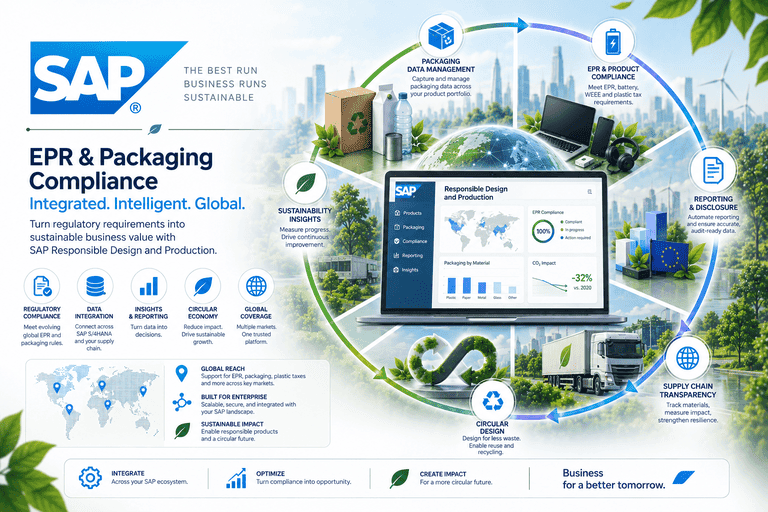
photo 2 sap

How SAP Company Software Handles Multi-Country EPR Obligations

It's worth being specific about what "multi-country" actually means at the operational level, because the word gets used loosely. For sap company clients operating across the EU, multi-country EPR means maintaining active registrations in each member state where products are placed on the market — not one registration, not a pan-European number, but separate scheme memberships in Germany, France, Italy, Spain, Austria, Poland, and wherever else sales are happening. Each of those registrations has its own reporting calendar, its own data submission format, its own fee calculation logic, and its own tolerance for errors.

SAP software addresses this by maintaining country-specific compliance modules that know the local rules. Germany's EAR Foundation requires packaging data broken down into specific material subcategories. France's CITEO has different weighting factors. The Italian system has historically required Italian-language documentation. A single sap software environment can hold these distinctions simultaneously, applying the right rules to the right market data without manual switching. The alternative — maintaining a spreadsheet matrix that tracks which country needs what, updated manually each time a regulation changes — is how compliance errors happen, and how fines accumulate.

The reporting workflow itself is triggered by the existing data flows inside the enterprise. A new product launch, a change in material composition, a shift in packaging weight — any of these updates the compliance position automatically across all active registrations. Companies that have implemented this find their compliance review meetings get much shorter. The conversation moves from "did we file correctly?" to "what does the data tell us about next year?"
What SAP Products Cover Across Different Regulatory Frameworks

The EU has not created a single unified EPR system, and there's no realistic prospect of one arriving soon. Each directive — the Packaging and Packaging Waste Regulation, the WEEE Directive, the Battery Regulation — operates through its own national implementation layer. So sap products for EPR compliance aren't a monolith; they're a configured environment that maps to whichever obligations a given business carries.

For producers of packaged goods, SAP products cover the material weight declaration requirements across the packaging regulation's scope — glass, plastic, paper, metals, composite materials. For electronics manufacturers, the WEEE stream tracks equipment categories and weights separately from packaging. Battery producers face the Battery Regulation requirements that came into full progressive effect from 2024, including collection target reporting that didn't exist under the old Battery Directive. A single business selling a battery-powered consumer device in a plastic box has packaging, WEEE, and battery obligations running simultaneously, all pulling from the same underlying operational data through the integrated sap products environment.

What this means practically: the compliance team doesn't maintain three parallel tracking systems. They maintain one. The outputs — three separate filings to three different sets of national scheme operators — are generated from that single data environment. Discrepancies between what you reported for packaging and what you reported for the device itself, which used to be a common source of regulatory queries, become rare. When the data flows from the same source, it's consistent.

The Real Integration Story — SAP ERP System and EPR Compliance Data

Here's what most vendor descriptions of EPR software get wrong: they talk about integration as if it's an add-on feature, something you configure after the main system is running. For a genuinely functional sap erp system connection, integration isn't a feature. It's the foundation.

The sap erp system holds the master data — bill of materials, material weights, product categories, sales orders by destination country. EPR reporting needs all of that. A solution that can't read directly from the ERP creates an extraction task — someone has to pull the data, clean it, reformat it, and push it into the compliance system. That person is usually a compliance manager who has better things to do in the weeks before a filing deadline. The sap erp system native integration removes that step entirely. The compliance platform reads from the same data structures that procurement and logistics already use. No extraction. No reformatting. No version control problems when the ERP data gets updated.

The practical outcome shows up most clearly at reporting time. Businesses that went from manual extraction to native ERP integration consistently report that the annual reporting cycle — which previously occupied a compliance team for weeks — compresses to days. Not because the regulatory requirements got simpler, but because the data is already there, already organised, already validated by the same quality controls the ERP applies to procurement data. The compliance team's job becomes reviewing outputs rather than building them.

Why SAP Business Software Makes Compliance Scalable Across Markets

Scalability is one of those words that gets attached to software products without much examination of what it actually means. For EPR compliance specifically, scalability means the ability to add a new market — say, Poland or Romania — without a corresponding spike in compliance team headcount or administrative complexity. That's what sap business software delivers in the EPR context.

SAP business software is built for enterprise complexity. The data architecture, the permissioning system, the workflow engine — these were designed for businesses managing operations across multiple countries with multiple legal entities, different tax regimes, and different reporting obligations. EPR compliance is, structurally, a similar problem: multiple countries, multiple schemes, different rules, parallel deadlines. Dropping an EPR compliance layer into a system that already handles that level of operational complexity is a different proposition than trying to bolt it onto a system designed for simpler environments.

For businesses currently using sap business software across their operations, the EPR compliance module connects to existing user management and role-based access structures. Regional compliance teams in Germany can see German data. The central compliance manager can see everything. Auditors can be given read-only access without touching production permissions. This isn't novel functionality — it's the standard enterprise access model applied to compliance data. But for organisations that have tried to manage EPR across regions using shared spreadsheet files, the contrast is significant.

The scalability argument also applies to regulatory change. When a national scheme changes its reporting format — which happens regularly — a SAP business software environment gets updated centrally. The change rolls out to all users simultaneously. With fragmented tools, every regional team has to update their own version of whatever they were using. The central update model is one of the underappreciated reasons why enterprises prefer it for compliance functions.

Getting Started Through the SAP Website and SAP Online Portal

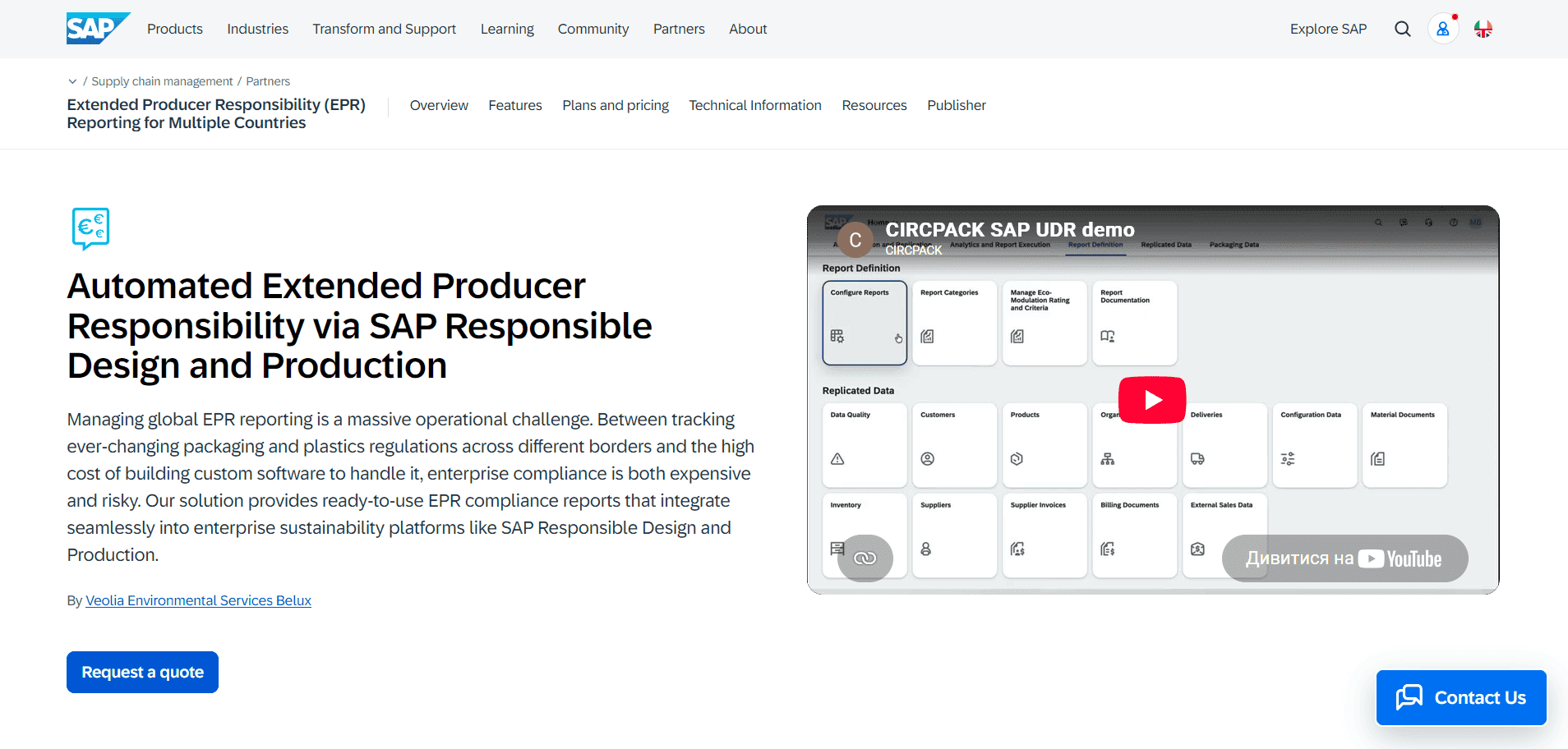
The entry point for organisations exploring this capability is the sap website, which maintains detailed product pages for the multi-country EPR solution, including implementation specifications, supported country lists, and integration requirements. The sap website also publishes the partner ecosystem information — which system integrators have certified experience with the EPR compliance module — which matters for procurement teams that need to plan implementation resources alongside the software decision.

SAP online access to the compliance module means that regional compliance staff in different countries aren't dependent on a centralised IT team to run reports or check registration status. The sap online environment is accessible through standard browser login, with mobile support for compliance managers who need to check deadline status or retrieve registration certificates while travelling between sites or market offices. This sounds like a minor convenience, but in practice it removes a significant friction point — the compliance manager who can't get a registration certificate to a customs officer because they're travelling and the system is desktop-only.

New implementations typically start with a configuration workshop where the scope of countries, product categories, and regulatory streams is mapped to the available modules. From that scoping exercise, the implementation timeline and data migration requirements become clear. Organisations with clean ERP master data — accurate material weights, consistent product category mapping — tend to complete implementation faster than those that need to resolve data quality issues alongside the compliance setup.

The sap website also hosts a regulatory news section that tracks changes across EU member states, which is useful for compliance teams wanting advance notice of upcoming changes before they affect filing deadlines or data requirements.

What a Software Solutions Company Delivers That Spreadsheets Cannot

The comparison between an enterprise EPR compliance platform and a spreadsheet-based approach gets raised often enough that it's worth addressing directly. Spreadsheets are flexible, familiar, and free — and they work adequately for a business with one or two active registrations in simple markets. The problem isn't the spreadsheet. The problem is what happens when the business grows, when regulations change, and when regulators ask questions.

A software solutions company building EPR compliance tools is designing for the failure modes of the spreadsheet approach. Version control is the obvious one — when six people in four countries are updating different copies of the compliance workbook, the version that gets filed is sometimes not the correct one. Audit trails are another: a software solutions company product maintains a complete log of who submitted what data, when, and what the source was. A spreadsheet doesn't. Regulatory inspectors increasingly ask for that audit trail, and "we believe the numbers are correct" is not a satisfying answer.

The less obvious limitation of spreadsheets is their fragility at scale. A packaging regulation change that requires splitting one material category into three requires updating the spreadsheet, all the formulas, the historical comparisons, and every regional variant. In an enterprise platform from a software solutions company, that change is a configuration update. The history is preserved, the new category is mapped correctly, and the next submission uses the right structure. The people hours saved by not having to manually rebuild compliance spreadsheets after each regulatory change are substantial. They're also genuinely hard to measure because they show up as avoided rework rather than obvious cost line items.

SAP Technology and What It Means for Environmental Reporting Accuracy

Environmental reporting accuracy is increasingly a legal matter rather than a best-efforts commitment. Regulators in Germany, France, and the Netherlands have been clear: incorrect EPR submissions — even unintentional ones — can result in fines, and repeated errors attract audit attention. The quality of data feeding into compliance reports therefore matters in a concrete way. This is where sap technology infrastructure makes a difference that's difficult to replicate with lighter tools.

SAP technology means, among other things, a transactional data environment with built-in validation at the point of data entry. A packaging material weight that doesn't fall within an acceptable range for its product category triggers a validation warning before it gets committed. An equipment category code that doesn't match any known WEEE category gets flagged before it reaches a report. These validation layers are part of how SAP technology handles data quality at enterprise scale, and in the EPR context they directly reduce the risk of regulatory submissions containing errors that could attract enforcement attention.

The reporting outputs generated from the platform carry a quality provenance that matters during audits. Every figure in every submission is traceable back to a source transaction in the ERP. That traceability — the ability to show exactly where a reported weight came from, which product batch it relates to, which sales order it was associated with — is the difference between an audit that closes in a day and one that takes weeks. Organisations that have been through a national scheme audit with good data lineage uniformly describe the experience as manageable. Those that have been through one relying on reconstructed spreadsheet histories describe it differently.

SAP Software Company Approach to Regulatory Change Management

Regulation doesn't stay still. The EU Battery Regulation introduced new requirements progressively from 2024. The revised Packaging Regulation brings changes to material scope and reporting timelines. WEEE collection targets shift. National implementations diverge. A sap software company working in this space needs a clear approach to managing that regulatory change on behalf of clients — not just updating the software, but ensuring that the compliance outputs remain correct as the rules evolve.

The sap software company approach to regulatory maintenance involves a combination of a dedicated regulatory intelligence function tracking change across all supported member states, a release cycle for compliance module updates that aligns with regulatory implementation timelines, and client communication protocols that give compliance teams advance notice of what's changing and when. For organisations using the platform, regulatory change becomes a managed process rather than a discovery event. They find out about a format change in the French CITEO submission three months before it takes effect, not three days.

The distinction matters financially as well as operationally. Missed deadlines resulting from late awareness of regulatory changes carry late-filing penalties in most member states. Data submissions in deprecated formats — filed correctly but using the previous year's template — get rejected, triggering correction processes that add administrative cost. A sap software company that maintains regulatory currency as part of its core product commitment removes that risk category from the client's compliance profile. It's not glamorous, but it's one of the more tangible financial arguments for enterprise EPR software over the alternatives.


SAP EPR Solution vs Alternative Approaches

Capability

SAP Multi-Country EPR

Standalone Compliance Tool

Manual Spreadsheet Approach

ERP data integration

Native, automatic

API connection (variable)

Manual export required

Regulatory update management

Centralised, included

Vendor-dependent

Self-managed

Multi-country simultaneous filing

Yes, across 10+ markets

Limited (3-5 typical)

Dependent on team capacity

Audit trail completeness

Full transaction lineage

Partial

Minimal

User access management

Enterprise role-based

Basic

Shared file access

Multi-stream compliance

Packaging, WEEE, batteries

Usually single stream

Separate files per stream

trade-e-bility Phone — Direct Communication for Battery Compliance

photo 3 sap

FAQ

SAP Multi-Country EPR Reporting Solution - EPR100