Pros
- Full lifecycle management
- Multi-market coverage
- Fast registration timeline
- Integrated WEEE+battery solution
- Authorised representative service

Take-e-way and trade-e-bility are two related compliance service platforms operating in the WEEE (Waste Electrical and Electronic Equipment) and battery EPR sector in Europe. Producers, importers, and online marketplace sellers that place electrical equipment or batteries on European markets use these platforms to fulfil their producer responsibility registration and reporting obligations. This profile covers what the two platforms do, how they differ, about our services offered to clients across the main enforcement-active EU markets, and how to reach the team via the take-e-way contact channels and the trade-e-bility phone line.
For any business that places electrical or electronic equipment — or standalone batteries — on the market in the EU, producer responsibility registration is not optional. The WEEE Directive and the EU Battery Regulation require producers to register with a national take-back scheme in every member state where they sell, report the quantities placed on the market each year, and contribute financially to the cost of collecting and recycling the products they introduce. For businesses based outside the EU, these obligations apply with equal force and require the appointment of an authorised representative in each relevant market.
take-e-way and trade-e-bility address this compliance challenge directly. take-e-way focuses on WEEE compliance — managing the registration, annual reporting, and scheme membership of producers who place electrical and electronic equipment on the EU market. trade-e-bility covers the battery EPR stream, handling the registration and reporting obligations that arise under the EU Battery Regulation for producers of portable batteries, light means of transport batteries, and other battery categories. Together, the two platforms provide a coordinated service for businesses whose products fall under both directives simultaneously — which is the case for the majority of consumer electronics and battery-powered device producers.
Both platforms are operated by the same underlying compliance organisation, which means that a business can manage WEEE and battery obligations through a single account relationship — with coordinated data collection, aligned reporting calendars, and a single point of contact for both streams. This integration is one of the practical advantages of using take-e-way and trade-e-bility over engaging separate compliance providers for each waste stream.
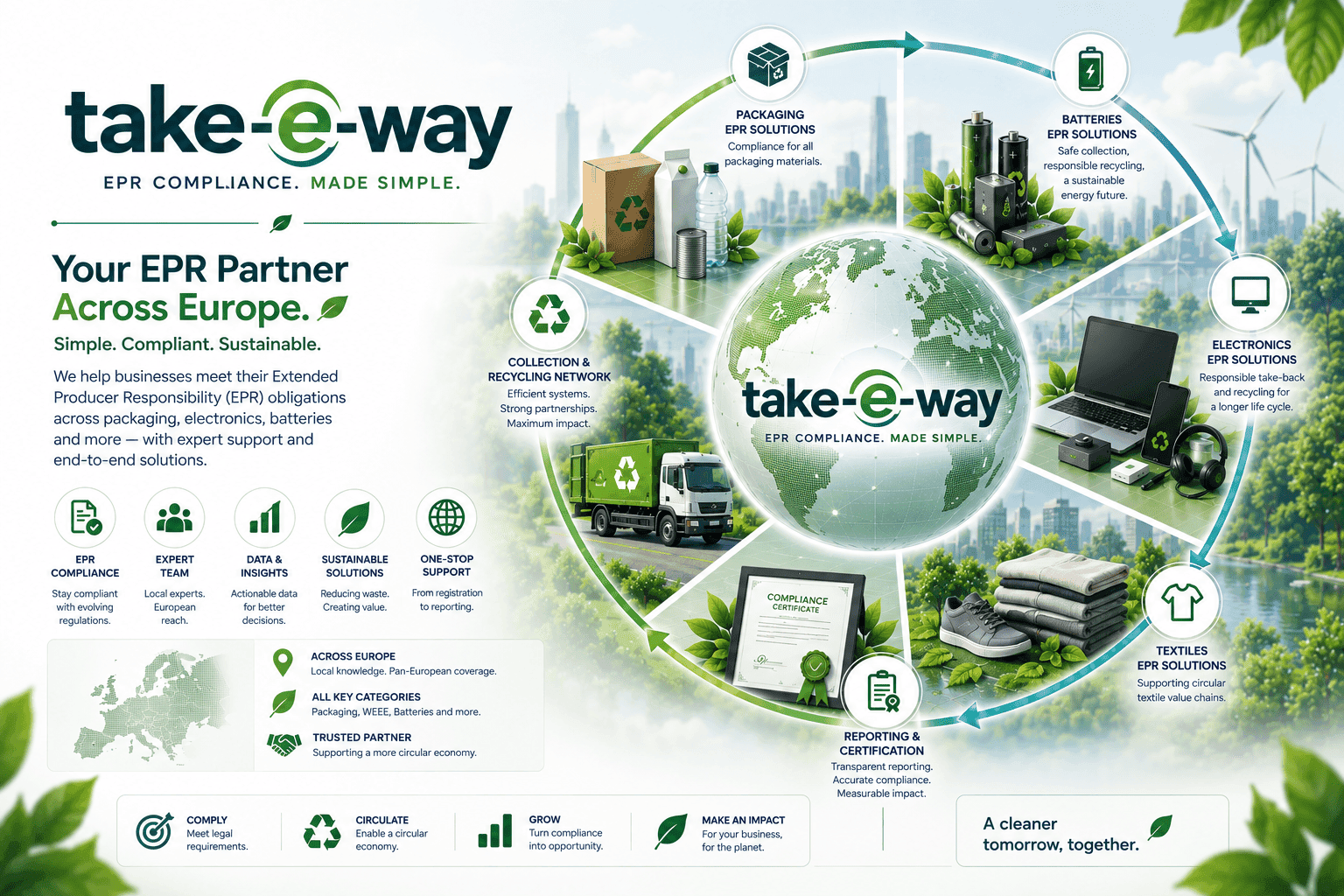
take-e-way is a WEEE compliance service provider that manages producer responsibility obligations for electrical and electronic equipment producers across the EU. Its core service covers the full compliance lifecycle: initial registration with the relevant national WEEE take-back scheme, preparation and submission of annual and periodic quantity reports, calculation of financial contributions to scheme-operated collection and recycling programmes, and ongoing regulatory liaison on behalf of registered producers.
The WEEE Directive, as implemented in each EU member state, requires any producer of electrical or electronic equipment to register before placing products on the market in that country. The definition of "producer" is broad — it includes manufacturers, importers, and in many cases online marketplace sellers who are deemed to be the importer into a given national market. For non-EU businesses, the directive requires the appointment of an authorised representative in each member state where products are sold. take-e-way can act in this authorised representative capacity alongside providing the underlying compliance management service, creating a single point of legal responsibility for WEEE obligations in each covered market.
Annual reporting under take-e-way involves submitting data on the weight of electrical and electronic equipment placed on the market in each country during the reporting period. This data is broken down by equipment category — large household appliances, small household appliances, IT and telecommunications equipment, consumer equipment, lighting equipment, and so on — because collection targets and financial contribution rates vary by category. The take-e-way platform guides producers through the data collection and submission process, validates submitted figures against expected formats, and files the completed reports with the relevant national scheme.
trade-e-bility is the battery EPR counterpart to take-e-way, managing producer responsibility obligations for businesses that place batteries on the EU market. The EU Battery Regulation (Regulation 2023/1542), which came into full effect progressively from 2024 onwards, significantly expanded and harmonised battery EPR requirements across all member states, replacing the earlier Battery Directive with a more demanding and more consistent regulatory framework.
Under the Battery Regulation, producers of portable batteries, industrial batteries, light means of transport (LMT) batteries, and automotive batteries must register in each EU country where they sell, join a national producer responsibility scheme, report quantities placed on the market, and demonstrate that collection and recycling targets are being met. Marketplace enforcement of battery EPR registration began actively in Germany from August 2025, and other member states are following with similarly active enforcement timelines.
trade-e-bility handles the complete registration and reporting workflow for battery producers. Its service includes scheme registration in each target market, annual data collection and submission, financial contribution calculation and disbursement, and regulatory correspondence. For businesses that sell battery-powered devices under take-e-way as well as standalone batteries under trade-e-bility, the two services can be coordinated to avoid data duplication and align reporting timelines.
About our services: the combined offering of take-e-way and trade-e-bility covers every step of the WEEE and battery EPR compliance process for producers operating in the EU. The scope is designed to remove the need for clients to interact directly with national WEEE registers, battery scheme operators, or regulatory authorities — handling all of this on their behalf through a managed service model.
The service begins before the first product is placed on the market. Eligibility assessment determines which national registrations are required based on the client's product categories, target sales countries, and estimated annual volumes. This step is important because WEEE and battery EPR thresholds and registration requirements vary between member states, and some smaller markets have different timelines for enforcement activation than the major EU economies.
Once the scope is established, the registration process begins. take-e-way and trade-e-bility submit registration applications to the relevant national schemes on the client's behalf, using their locally established entities or national scheme partner network as required. The client receives the resulting registration numbers — which must be displayed on products, packaging, and marketplace seller accounts — as soon as they are issued by each national authority. For a detailed breakdown of what is included, see the about our services section of the respective platform websites.
Ongoing compliance management covers the full annual reporting cycle in each registered market. Data collection requests are sent to the client in advance of each reporting deadline, with templates pre-formatted for the specific requirements of each national scheme. Submitted data is validated before filing, and the completed reports are archived in the client account for future reference. Fee calculations are provided transparently, and eco-contribution payments are managed on the client's behalf where the scheme structure permits.
Service element | take-e-way (WEEE) | trade-e-bility (Batteries) |
Eligibility assessment | Yes — by equipment category and market | Yes — by battery category and market |
National registration | All major EU markets | All major EU markets |
Authorised rep appointment | Available for non-EU producers | Available for non-EU producers |
Annual quantity reporting | By equipment category and weight | By battery category and weight |
Fee calculation and payment | Managed on client behalf | Managed on client behalf |
Regulatory correspondence | Handled by take-e-way team | Handled by trade-e-bility team |
Document archiving | Registration certs, submissions, fee records | Registration certs, submissions, fee records |
Marketplace number provision | WEEE reg number for Amazon, eBay etc. | Battery reg number for Amazon etc. |
A significant proportion of the businesses that use take-e-way and trade-e-bility are online marketplace sellers rather than traditional manufacturers or importers with established retail distribution. The growth of marketplace EPR enforcement — particularly on Amazon Europe, which actively verifies WEEE and battery registration numbers before allowing product listings in Germany, France, Spain, Italy, and other markets — has created an urgent compliance need for sellers who previously operated without awareness of producer responsibility obligations.
For marketplace sellers, the most pressing element of our services is speed of registration. A seller facing a listing suspension in Germany because of a missing WEEE number from the EAR Foundation, or a missing battery registration with the Stiftung EAR, needs the registration completed and the number issued as quickly as possible. take-e-way and trade-e-bility offer expedited registration tracks for clients with active marketplace compliance deadlines, prioritising the highest-urgency markets in the onboarding sequence.
Beyond the initial registration, the ongoing elements of our services for marketplace sellers include annual reporting management, renewal of scheme memberships, and updating of registration details when product categories or sales volumes change materially. Marketplace platforms periodically re-verify EPR compliance status, and an expired or lapsed registration can trigger a listing suspension just as easily as a missing one. The managed renewal service within take-e-way and trade-e-bility ensures that registrations remain current without requiring the seller to track individual market deadlines manually.
take-e-way and trade-e-bility cover the major EU markets where WEEE and battery EPR enforcement is most active, as well as the UK under its post-Brexit producer responsibility framework. The geographic scope is updated as new national markets activate enforcement or as existing markets introduce new requirements for non-EU producers.
Market | WEEE scheme | Battery scheme | Marketplace enforcement |
Germany | EAR Foundation | Stiftung EAR | Very high — listing removal active |
France | Ecosystem / Ecologic | Approved scheme | High — spot checks active |
Italy | CdC RAEE | National scheme | Medium — increasing from 2025 |
Spain | Ambilamp / others | National scheme | Medium — NIF enforcement strict |
Netherlands | Wecycle / ICT Milieu | National scheme | Medium-high |
Poland | National register (BDO) | National scheme | Medium — growing |
UK | Compliance scheme (UK) | UK Battery scheme | Medium — separate from EU |
The take-e-way contact options are published on the take-e-way website and cover both telephone and written communication channels. For producers with active compliance questions or onboarding enquiries, the contact team operates during standard European business hours and aims to respond to all enquiries within one business day.
The primary take-e-way contact route for new clients is the enquiry form on the take-e-way website, which requests basic information about the business — including the product categories sold, the EU markets targeted, and an estimate of annual quantities — so that the initial response can include a preliminary assessment of WEEE obligations and an indicative fee range. This structured intake process avoids the back-and-forth of a generic enquiry and delivers a more useful first response.
Existing clients access their dedicated compliance manager directly through the platform account or via the direct contact details provided during onboarding. The take-e-way contact system routes account queries to the assigned manager rather than a generic support queue, ensuring that responses are informed by knowledge of the client's specific compliance profile and registration history.
For urgent situations — a marketplace listing suspension triggered by a missing or expired WEEE registration, a regulator query requiring a same-day response, or a data submission error discovered close to a filing deadline — the take-e-way contact team offers priority handling. Clients should flag the urgency explicitly when making contact to ensure the query is escalated appropriately within the team's routing system.
The trade-e-bility phone line provides direct voice access to the battery compliance team for producers with time-sensitive questions about registration status, reporting deadlines, or scheme membership. Battery EPR enforcement timelines have accelerated significantly since the EU Battery Regulation took effect, and the trade-e-bility phone channel exists to ensure that producers facing imminent compliance issues can speak directly to a specialist without delay.
The trade-e-bility phone number is listed in the Contacts section of the trade-e-bility website, alongside the regional office locations from which support is provided. For clients whose battery compliance obligations span multiple EU markets, the support team is organised to provide guidance across all covered jurisdictions from a single contact rather than routing calls between different national offices.
Common reasons for using the trade-e-bility phone channel include: confirming that a battery registration number has been issued and is ready for use on a marketplace account; checking the status of a pending registration application in a specific market; clarifying the data format required for an upcoming submission; and requesting confirmation of scheme membership certificates for audit or due diligence purposes.
For non-urgent queries, the website contact form and email channel serve as the primary written route to the trade-e-bility team. The phone line is most valuable when speed of response matters — which, given the marketplace enforcement environment for battery EPR, is increasingly the case for sellers active on Amazon and other major European platforms.
About our services at take-e-way and trade-e-bility: the onboarding process is designed to move quickly and require minimal effort from the client beyond providing the product and business information needed to complete each national registration. For most clients, the sequence from first contact to issued registration number takes between five and fifteen business days, depending on the number of markets in scope and the speed of document provision.
For the majority of businesses selling consumer electronics, household appliances, or any battery-powered product in the EU, both WEEE and battery EPR obligations apply simultaneously. A laptop producer, for example, is a WEEE producer (the device is electrical and electronic equipment) and a battery producer (the built-in battery falls under the Battery Regulation) at the same time. Managing these two streams separately through different providers creates duplicated administrative work and risks misalignment between the data reported under each stream.
The coordination between take-e-way and trade-e-bility addresses this directly. Because both platforms are operated by the same underlying compliance organisation, a single account relationship covers both streams. Data on product weights collected for WEEE reporting and data on battery weights collected for battery reporting are gathered through a coordinated process rather than two separate ones. Reporting calendars for both streams are managed in alignment, and the assigned compliance manager holds responsibility for both sets of obligations under a single service agreement.
This integrated approach is particularly valuable for businesses entering multiple EU markets at the same time. Coordinating WEEE registrations in eight countries simultaneously with battery registrations in the same eight countries — managing different national schemes, different registration portals, different submission formats, and different deadline calendars — is a significant administrative burden when handled independently. Through take-e-way and trade-e-bility together, this complexity is reduced to a single managed workflow.
The cost of engaging take-e-way and trade-e-bility comprises a service fee charged by the platforms for managing the compliance process, plus the eco-contribution fees payable to national WEEE and battery schemes based on reported quantities. Both components are provided transparently before any commitment is made.
Service fees for take-e-way are structured by market and by the WEEE equipment categories in scope. Businesses registering in a single market under a single equipment category pay a lower service fee than those with multi-market, multi-category obligations. Bundled pricing is available for businesses registering simultaneously under both take-e-way (WEEE) and trade-e-bility (batteries), reflecting the operational efficiencies of managing both streams through the same compliance organisation.
Eco-contribution fees — the amounts paid to national WEEE and battery schemes — are calculated from reported quantities after each reporting period. trade-e-bility and take-e-way provide fee estimates before the first reporting cycle based on projected volumes, allowing the total annual compliance cost to be budgeted. Actual fees are reconciled against submitted figures after each reporting period. In markets where modulated fees apply based on repairability, recyclability, or the presence of hazardous substances, the team advises clients on the factors that affect their fee level.
Table 3. Indicative cost components for take-e-way and trade-e-bility services
Cost component | Description | Basis |
take-e-way service fee | Annual fee for WEEE compliance management per market | Per market, with bundle discounts |
trade-e-bility service fee | Annual fee for battery EPR compliance management per market | Per market, with bundle discounts |
Eco-contribution — WEEE | Fee per kg of EEE placed on market, paid to national WEEE scheme | Per kg by equipment category |
Eco-contribution — Batteries | Fee per kg of batteries placed on market, paid to national battery scheme | Per kg by battery category |
Authorised rep fee | Additional fee if acting as EU authorised rep for non-EU producer | Per market per year |
Registration fees | One-time or annual fee payable to national authority on registration | Varies by market, €0–€250 |
Non-EU producers — including businesses based in the United Kingdom, United States, China, Australia, and any other country outside the EU — are required to appoint an authorised representative in each EU member state where they place WEEE or batteries on the market. This representative assumes legal co-responsibility for the producer's compliance obligations in the country of appointment and is the named contact for the national authority on all EPR matters.
take-e-way and trade-e-bility can act as the authorised representative for non-EU producers in the markets they cover, combining the legal appointment with the underlying compliance management service. This means that a non-EU business engaging both platforms needs only one service relationship to cover both the authorised representative requirement and the ongoing WEEE and battery EPR obligations — rather than separately appointing a legal representative and a compliance service provider.
UK businesses are specifically affected by this requirement following Brexit. Since 1 January 2021, UK-based producers selling WEEE or batteries in EU markets must appoint an EU-based authorised representative, just as any other non-EU producer would. The take-e-way contact and trade-e-bility phone channels are both available to UK businesses navigating this requirement for the first time, and the onboarding process has been specifically adapted to handle the common documentation and registration scenarios for UK-to-EU market entry.
Our services at take-e-way and trade-e-bility are designed to sit within a broader EPR compliance ecosystem. Many producers that use take-e-way and trade-e-bility for WEEE and battery compliance also have packaging EPR obligations in the same markets — meaning that they need registration and reporting services for three separate waste streams simultaneously.
The take-e-way and trade-e-bility service model is designed to be compatible with packaging EPR compliance services provided by other platforms or advisers. Reporting calendars, data collection processes, and regulatory correspondence structures are organised in a way that allows clients to manage multi-stream compliance without creating conflicts or duplications between different service relationships.
For clients who want a single provider to handle all three streams — packaging, WEEE, and batteries — the compliance organisation behind take-e-way and trade-e-bility can extend our services to cover packaging EPR in the same markets, creating a fully integrated compliance solution. This option is particularly attractive for businesses entering multiple EU markets at the same time, where managing onboarding across all three streams simultaneously through a single team reduces coordination effort and speeds up the overall registration timeline.
take-e-way is a WEEE (Waste Electrical and Electronic Equipment) EPR compliance service that manages producer responsibility registrations and annual reporting for businesses placing electrical or electronic equipment on the EU market. It handles national scheme registration, quantity reporting, eco-contribution fee management, and regulatory correspondence on behalf of producers in all major EU enforcement markets. For non-EU producers, take-e-way can also act as the legally required authorised representative in each covered market. Businesses that need to speak with the team directly can use the take-e-way contact details listed on the platform website.
The take-e-way contact options are available on the take-e-way website and include an online enquiry form, an email address, and a telephone number for direct team access. For new registration enquiries, the recommended first step is to complete the website enquiry form, which gathers the key information — product categories, target markets, estimated annual volumes — needed for a meaningful initial response. The team aims to acknowledge all new enquiries within one business day and to follow up with a preliminary scoping assessment and indicative fee information. Existing clients access their dedicated compliance manager directly through the platform account using the contact details provided during onboarding.
About our services for non-EU producers: both take-e-way and trade-e-bility provide authorised representative appointment in addition to standard compliance management. A non-EU producer engaging take-e-way for WEEE compliance and trade-e-bility for battery compliance can use both platforms as its EU authorised representatives in the covered markets, without needing to arrange separate legal representation. The authorised representative service covers the legal appointment, registration with the relevant national authority using the representative's local entity, and regulatory correspondence on the producer's behalf. UK businesses are treated as non-EU producers for these purposes following Brexit and can access the full range of our services on the same basis as any other non-EU producer.
Once all required documentation has been received, take-e-way and trade-e-bility can typically complete initial registrations in the major EU markets within five to fifteen business days. Germany and France — the two highest-enforcement markets — have established online portals that support relatively fast processing once the application is submitted. Some smaller member states may take slightly longer depending on national authority processing times. For clients with urgent marketplace compliance deadlines, the take-e-way contact and trade-e-bility phone teams offer an expedited onboarding track that prioritises the most urgent markets first. The registration number is provided to the client as soon as it is issued by the national authority and can be added to marketplace accounts immediately.